30 
 ASIAN TIMBER 
 MARCH/APRIL 2003
S
pecial 
F
eature
R
ecent studies by FAO (Food and Agriculture Organisation
of the United Nations), World Bank and ITTO (International
Tropical Timber Organisation) have indicated a deteriorating
state of the world’s forests. This is attributed largely to such causes
as over-use (excessive exploitation), abuse (clearing of forest for food
crops) and sheer replacement in favour of other competing uses (such
as agriculture, mining and township).
The deteriorating state of the forest poses a real threat to
environmental security in terms of adverse changes in climate,
biodiversity losses and pollution. It could also result in the
deprivation of economic benefits to the society, particularly
communities that are dependent upon the forest for their welfare.
Growing public awareness of forest destruction and degradation
has led consumers to demand that their purchases of wood and other
forest products will not contribute to this destruction but rather help
to secure forest resources for the future. In response to this demand,
certification and self-certification programmes of wood products
have proliferated in the marketplace.
By obtaining certification, producers and sellers of wood products
can demonstrate to their customers that they are committed to
protecting the world’s forests for future generations while bringing
a quality product to the marketplace.
World-standard forest management - The FSC standard
The Forest Stewardship Council (FSC) is an international body that
introduced international labelling schemes for forest and forest
products to provide a credible guarantee that these products come
from a well-managed forest.
The goal of FSC is to promote environmentally responsible, socially
beneficial and economically viable management of the world’s
forests by establishing a worldwide standard of recognised and
respected Principles of Forest Stewardship. FSC provides
international certification principles and criteria that include
performance standards with some procedural elements.
The FSC’s Principles and Criteria (P&C) apply to all tropical,
temperate and boreal forests. Many of these P&C apply also to
plantations and partially replanted forests. It covers three main issues
related to timber resource management, forest ecosystems and social
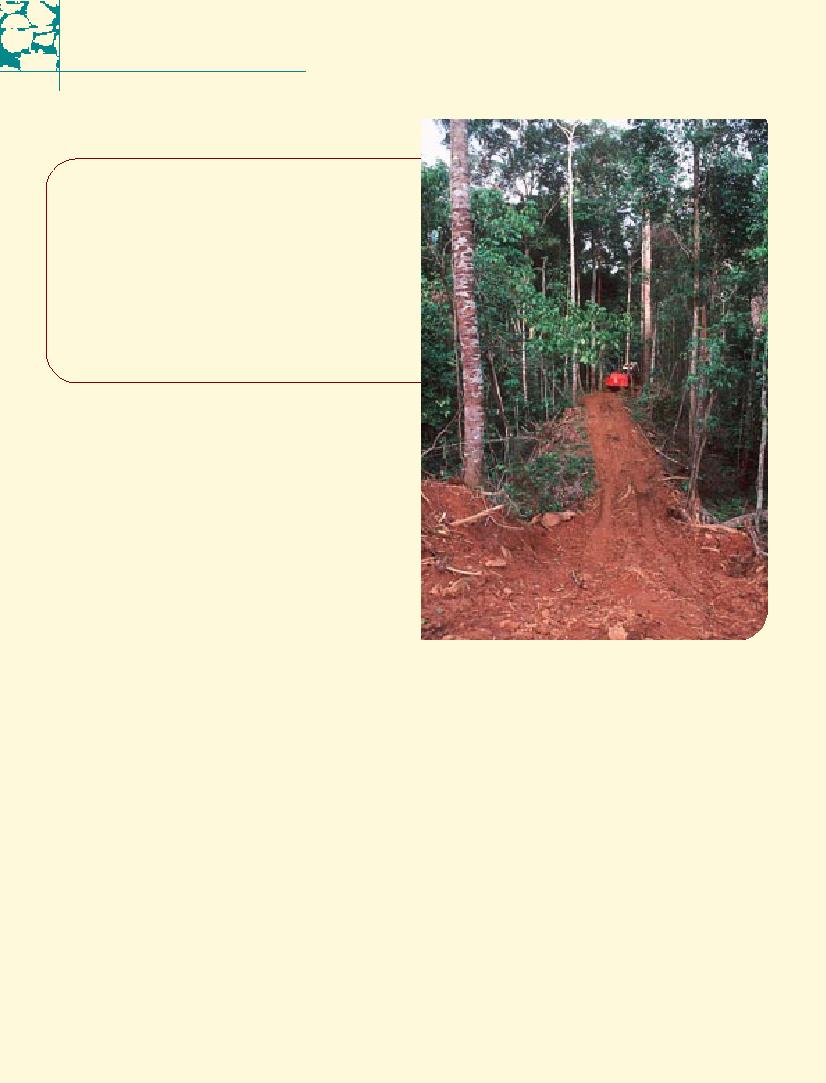
World-Standard
Forest Management
and Chain of Custody
Certification
The Forest Stewardship Council (FSC) is an international
body that introduced international labelling schemes
for forest and forest products to provide a credible
 guarantee that these products come from a well-managed forest
The goal of FSC is to promote environmentally responsible, socially beneficial and
economically viable management of the world’s forests.
pg_0002
S
pecial 
F
eature
MARCH/APRIL 2003 
 ASIAN TIMBER 
 31
aspect. Due to the diversity of forestry
situations, it is recognised that any
international standards have to be adjusted
to suit local situations. Such adjustment can
be made through national initiatives by all
stakeholders or the certification body itself.
The P&C is the base document that needs to
be implemented by the forest managers.
They have to be incorporated into the
evaluation systems of all certification
organisations seeking accreditation by FSC.
Rigorous Evaluation Procedure
The FSC has developed rigorous procedures
and standards to evaluate whether
organisations (certification bodies) can
provide an independent and competent
evaluation (certification) service. This process
is known as “accreditation”. FSC-accredited
certification bodies are required to evaluate
all forest managers or forest owners before
they are allowed to carry the FSC logo on their
product or company documentation.
Accreditation is required to give certification
bodies credibility with regard to their
procedures and quality of assessment. It acts
as a higher body that will ensure that every
certification body plays by the rules and
procedures and provides confidence in the
marketplace.
The accreditation body assesses the
resources and competence of certification
bodies in view of carrying out their tasks in
an independent and reliable manner. The
accreditation body licenses or franchises
certification bodies to operate, provided that
they follow the defined rules.
Three elements are important in the
evaluation for accreditation:
(i)Independence of the certification body,
(ii)Certification procedure, and
(iii)Professional skills.
The third element is particularly important
in the case of forest management, as the
performance standards have to be correctly
interpreted at the local (site) level requiring
a through knowledge and understanding of
the specific ecosystems and social
conditions.
All accredited certification bodies may
operate internationally and carry out
evaluations in any forest type. The
performance of the certification bodies is
monitored closely by the FSC. Certified
organisations are visited on a regular basis
in order to ensure they continue to comply
with the requirements.
FSC Certification Schemes
a. Forest Management Scheme
Forest Management Certification scheme is
the process of inspecting a particular forest
or woodland (Forest Management Unit) to see
if they are being managed according to an
agreed set of standards of the 10 principles
and criteria established by the FSC.
Competent assessors will rigorously assess
Forest Management Units for compliance to
the P&C. Assessors are selected based on
working experience and field of expertise.
They will spend an appropriate amount of
time in the field and in the office to look for
objective evidence of compliance. The
amount of time depends on the forest size
and complexity. The number of assessors
involved varies from a minimum of two
people.
Once a forest is certified under the FSC as
being “well managed”, a certificate of
compliance will be issued to the Forest
Management Unit. The certificate is usually
valid for up to five years and the
management unit is subjected to annual
surveillance in order to ensure continuous
compliance and maintenance of the system.
b.  Chain of Custody Certification
Chain of Custody  (COC) is a process in
which timber products are verified. It
provides a system for tracking certified
wood from the forest through each stage of
production, distribution and to the point of
sale.  It requires organisation to establish
systems that create a paper trail
demonstrating certified materials are kept
The Chain of Custody process provides a system for tracking certified wood.
Once a forest is certified under the FSC as being “well
managed”, a certificate of compliance will be issued to
the Forest Management Unit.
pg_0003
32 
 ASIAN TIMBER 
 MARCH/APRIL 2003
S
pecial 
F
eature
separate from non-certified, and can be
accurately tracked to maintain their identity
and authenticity throughout the
manufacturing and distribution process.
To comply with the scheme, organisation is
required to establish a Chain of Custody
system in accordance to FSC COC principles.
An assessor will assess the Chain of Custody
system before a certificate of compliance is
issued. Assessment time varies depending
on the organisation’s size and complexity.
The assessor will verify its system of
segregation between certified and non-
certified wood, inventory, storage, labelling,
records from receiving of raw material until
delivery of finished products. Each
organisation is subject to an annual
surveillance audit in order to ensure
continuous compliance to the six FSC COC
principles.
Products originating from forests certified by
FSC-accredited certification bodies are
eligible to carry the FSC logo to indicate that
the product originates from a well-managed
forest.
Scientific Certification Systems
(SCS)
Established in 1984, Scientific Certification
Systems (SCS) has evolved to become a
certifier of multiple facets of the food
industry and the environmentally sound
management of forests, marine habitats
and a wide variety of businesses.
SCS introduced its Forest Conservation
Programme in 1991 and has been
accredited by the FSC. In the SCS Forest
Conservation Program, SCS audit the
practices of forest managers and certify
them under the FSC standards and
principles as “well managed”. The
forestry programme also includes FSC
Chain of Custody certification for
handling certified forest products from
wood to the market such as wholesalers,
manufacturers, distributors and
retailers.
Since its inception, SCS has certified
more than 12 million acres of natural
forests and plantations in Central, South
and North America, Europe, Asia and
New Zealand.
As part of SIRIM QAS’ commitment to
the environment, a collaborative agreement was
signed with Scientific Certification Systems (SCS)
in 2000 to provide FSC-endorsed Forest Management
Certification and Chain of Custody
Certification schemes
The main phases of forest management certification process
Full Evaluation team
Document review
Field assessmentConsultation with stakeholders
Submission of the draft report and comments by the applicant
Peer Preview
Certification decision by SCS
Periodic review of compliance
Application
Preliminary Evaluation
Proposal and contracting of the certification body
pg_0004
S
pecial 
F
eature
MARCH/APRIL 2003 
 ASIAN TIMBER 
 33
pg_0005
34 
 ASIAN TIMBER 
 MARCH/APRIL 2003
S
pecial 
F
eature
Through its Chain of Custody Certification,
SCS has audited and certified around 400
manufacturers, distributors and retailers
who make or carry certified wood products.
SIRIM QAS Gains International
Recognition
With over 25 years of experience in quality
assurance, Malaysia-based SIRIM QAS
International Sdn Bhd has achieved wide
recognition both nationally and
internationally. The company provides a
comprehensive range of certification,
inspection and testing services that conform
to various international standards and
guidelines. This includes certification of
Quality Management System (ISO 9001), QS
9000, Environmental Management System
(ISO 14001), Occupational Health and Safety
Management System (OHSAS 18001).
As a certification, inspection and testing
body, SIRIM QAS is accredited by DSM
(Department of Standards Malaysia) and
UKAS (United Kingdom Accreditation
Service). This accreditation provides the
public an assurance that SIRIM QAS’
certification and testing services meet
internationally agreed criteria covering
integrity, technical competence and validity
of methods.
As part of SIRIM QAS’ commitment to the
environment, a collaborative agreement was
signed with Scientific Certification Systems
(SCS) in year 2000 to provide FSC-endorsed
Forest Management Certification and Chain
of Custody Certification schemes.
Under the SCS-SIRIM QAS collaborative
programme, two forestry companies, eight
manufacturers and a trader in Malaysia
have been FSC-certified for Forest
Management and Chain of Custody
(COC) Certification respectively.
SCS-SIRIM QAS Certification
Process
a) Forest Management Certification
Scheme
At the request of the client and once
a contract is executed, SCS-SIRIM
QAS determines the scope of the
project and selects local experts in the
relevant fields of forestry, biology
and economics to function as the
evaluation team. Field experience,
regional expertise and regional
credibility are crucial factors
considered in selecting these
evaluators.
The certification process normally involves
two evaluation steps, namely the
Preliminary Evaluation and Full Evaluation.
The Preliminary Evaluation is to help
ascertain the probability for a successful
certification. The information gathered
during this stage will be used for estimating
cost and time frame needed for the Full
Evaluation.
Full Evaluation is conducted upon
confirmation from the client. Subsequently,
SIRIM QAS will conduct initiation steps
(standard regionalisation, stakeholders
notification and consultation) and assemble the
evaluation team. The information gathered
during this audit is obtained through various
sources, such as clients, stakeholders,
government agencies and NGOs.
A report will be prepared and then peer
reviewed by independent regional experts
prior to recommendation for certification
under SCS certification scheme.
b) Chain of Custody Certification Scheme
Upon request from the client and once a
contract is executed, SIRIM QAS determines
the scope of the project. The client is requested
to submit a set of documentation prior to the
audit. After reviewing the information, an
auditor will be appointed to conduct a site
audit. A report will be prepared and
submitted to SCS for review and approval.
To become certified, the client must maintain
adequate inventory control system to allow
for separation and identification of certified
materials and products.
The audit requires the tracking of certified
input throughout the production process in
order to ensure the validity of the certified
claim. If a wood product carries the FSC
label, a customer can have confidence that it
is made from an FSC-certified forest. 
A
T
This article is provided by SIRIM QAS
International Sdn Bhd. Photos are courtesy of
Perak ITC Sdn Bhd.
The Chain of Custody Certification process
If a wood product carries the FSC label, a customer can have confidence that it is made from an FSC-certified forest.
Proposal and contracting of the certification body
Periodic review of compliance
Submission of the draft report and
comments by the applicant
Audit
Certification decision by SCS
Application
Document review
Operation assessment